High-Throughput Surface Mobility
Latin American Bus Rapid Transit Innovations
When heavy rail tunnels cost $300M+ per kilometer, how do fast-growing Global South metropolises move millions of daily workers? Latin America answered by inventing and perfecting Bus Rapid Transit (BRT)—delivering metro-grade passenger throughput at street level.
Pioneering Masterplan
Curitiba’s Rede Integrada de Transporte (RIT)
In 1974, under Mayor and architect Jaime Lerner, Curitiba, Brazil revolutionized transit planning by establishing the world's first true Bus Rapid Transit system. Lerner realized that standard buses were slow not because of vehicle mechanics, but because of friction: boarding steps, ticket payments at the driver's seat, and mixing with automobile traffic.
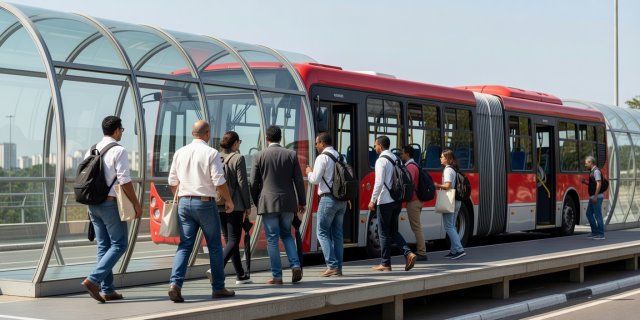
Curitiba resolved all three through iconic tubular boarding pods featuring pre-board fare payment, hydraulic ramps enabling level wheelchair boarding, and center-running exclusive rights-of-way bordered by designated arterial zoning. High-density residential towers were legally mandated along structural bus corridors, aligning transit supply precisely with commercial demand.
Maximum Throughput
Bogotá’s TransMilenio: Metro-Scale Capacity
In 2000, Colombia’s capital took BRT to unprecedented scale. Bogotá’s TransMilenio features dual passing lanes at stations, allowing express buses to bypass local services. This operational design propelled TransMilenio to peak capacities of 48,000 passengers per hour per direction (PPHPD)—surpassing the capacity of many modern underground subway lines.
TransMilenio demonstrated that rubber-tired vehicles on dedicated concrete rights-of-way could achieve subway-level passenger volumes at approximately 10% of the capital cost, providing an immediate blueprint adopted from Istanbul (Metrobus) to Guangzhou and Mexico City (Metrobús).
Decarbonization & Fleet Electrification
Santiago & Medellín: The Electric Transition
While early BRT systems faced criticism regarding diesel particulate emissions and fleet crowding, newer iterations have focused on full fleet electrification. Santiago, Chile operates over 2,000 electric buses on its RED Movilidad network, representing one of the largest electric public transport fleets outside of the People's Republic of China.
In Medellín, the Metrocable aerial cable-car network seamlessly feeds hillside informal settlements into the city's electric Metro and BRT spine, proving that multi-modal transit equity can bridge severe geographic barriers.
System Comparison
Global BRT Network Efficiency Ledger
| Metropolis / System |
Network Length |
Peak PPHPD Throughput |
Passing Lanes at Stations |
Fleet Decarbonization Rate |
| Bogotá (TransMilenio) |
114.4 km |
~48,000 PPHPD |
Yes (Standard feature) |
Over 1,480 pure BEV units |
| Curitiba (RIT) |
81.0 km exclusive |
~22,000 PPHPD |
Partial corridors |
Biofuel & Electric pilot |
| Istanbul (Metrobus) |
52.0 km |
~40,000 PPHPD |
Single-lane highway median |
Hybrid & Euro VI diesel |
| Santiago (RED Movilidad) |
Integrated bus/BRT corridors |
~18,000 PPHPD |
Select trunk arterials |
>50% full battery-electric |
Run the Transit Efficiency Manifest Tool